The name on the van tells you almost nothing about who is legally responsible for the driver. That answer is contractual, and it differs sharply between the three delivery models operating in San Antonio.
The IIHS studied light vans over the six years from 2016 through 2021 and found an annual average of 155,895 police-reported crashes, 16,352 injury crashes, and 606 fatal crashes. The distribution of harm is the important part: in more than 60% of the injury crashes and more than half of the fatal crashes, the people hurt were occupants of other vehicles, pedestrians, or cyclists — not the delivery driver.
E-commerce sales jumped 43% in 2020 and the fleet grew with it. Roughly half a million light vans are now sold in the United States every year, and they operate in residential neighborhoods, on tight schedules, with drivers who stop and start hundreds of times a shift.
If you were hit by a delivery van or truck in San Antonio, the first real question is not how badly you were hurt. It is who employed the driver — because the answer determines whether a company with substantial insurance is a defendant, or whether you are looking at a small contractor with a modest policy.
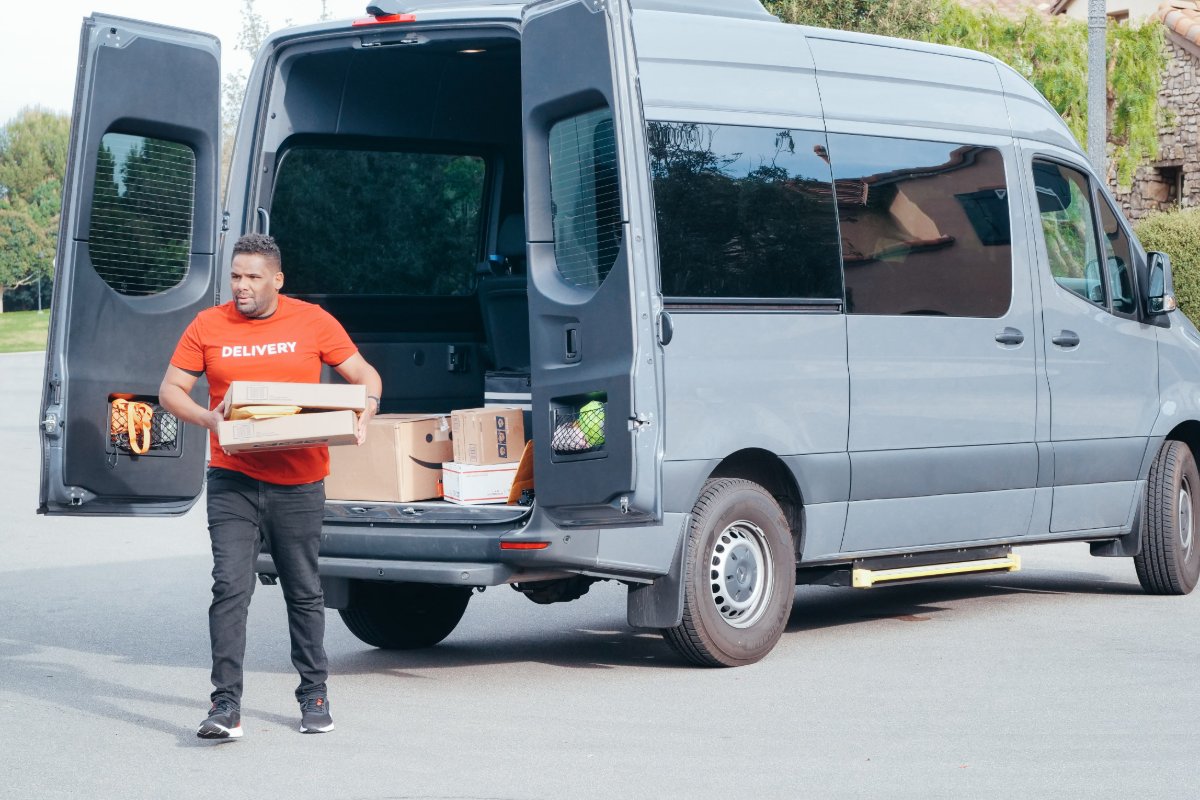
The dominant e-commerce delivery model does not employ the drivers at all. The national company contracts with thousands of small independent delivery businesses, each a separate corporation with its own insurance — frequently a modest commercial auto policy.
The plaintiff’s argument in these cases is about control, and it is usually built from the national company’s own public statements. These programs typically supply the branded vehicle, the routing and delivery application that sets the sequence and pace of the route, the training curriculum, and — increasingly — in-vehicle camera systems that monitor and score how the driver drives.
Companies publish the results of that monitoring, and those figures cut both ways. One national network reports that its camera program produced a 48% reduction in accident rates across its U.S. fleet, a 93% decrease in distracted driving, and a 90% reduction in speeding. Those are safety achievements. They are also the company quantifying how much influence it exercises over the driver’s behavior behind the wheel.
Practically, it also means the footage and the telematics exist, and they sit with the national company rather than the local contractor. A preservation demand addressed only to the contractor will not reach them.
Two out-of-state verdicts are cited constantly in this area. In Bradfield v. Amazon Logistics, a State Court of Gwinnett County, Georgia jury returned $16.2 million in August 2024 and apportioned 85% of responsibility to Amazon Logistics, finding it exercised sufficient control over the contracting company and separately that it failed to provide proper driver-safety training. In December 2023 a Dorchester County, South Carolina jury returned $44.6 million, including $30 million in punitive damages, in a case involving a contract driver.
Two honest caveats. Neither is Texas precedent — those states apply their own law, and Texas applies its own right-to-control test. And other courts have declined to extend liability on comparable facts. Outcomes here are fact-specific and split; the cases that succeed turn on app-based operational control and on direct negligent-training theories, not on any categorical rule.
The second structure looks similar but is older and differently documented. Pickup-and-delivery and linehaul work is performed by contracted independent service providers — incorporated businesses that employ the drivers under an operating agreement with the national parcel company.
Whether that label matches reality has been litigated for two decades. The leading decision, Alexander v. FedEx Ground Package System, Inc., 765 F.3d 981 (9th Cir. 2014), held that the drivers were employees rather than independent contractors under California’s right-to-control test, notwithstanding what the operating agreement called them.
That case is useful and it is routinely overstated. Alexander was an employment-law classification decision — wage and hour, expense reimbursement — applying California law. It is persuasive analogy on how much control the company actually exercises. It is not a holding on tort vicarious liability, and Texas applies its own test. Any page telling you courts have held these companies liable for their contractors’ crashes is describing something the cases do not say.
Note also that the less-than-truckload freight arm of such a company is usually a different entity with employed drivers in company-owned tractors, where vicarious liability is straightforward. In October 2021 a Harris County, Texas jury returned a $30 million verdict against FedEx Freight arising from a nighttime head-on collision on US-59, apportioning 51% to the company and 49% to its driver. That 51% mattered: under Tex. Civ. Prac. & Rem. Code § 33.013, exceeding 50 percent responsibility triggers joint and several liability.
Establishing which entity operated the vehicle is therefore the first task, not a detail.
The third model is the simplest. Some national carriers employ their drivers directly, most of them under a collective bargaining agreement, with no contracting entity in between.
Where the driver was on route, respondeat superior is generally uncontested. There is no contractor-status defense and no threshold fight over whether the right defendant is in the case. The dispute moves immediately to causation, damages, and direct-negligence theories — hiring and qualification, training, scheduling and dispatch pressure, route design, and vehicle maintenance.
It is worth understanding this contrast even if your crash did not involve such a carrier, because it shows what the other two structures are actually doing: placing a corporate layer between the brand and the driver. Whether that layer holds is the central question in most last-mile cases.
One more variation to know about: app-based gig delivery in a personal vehicle. Personal auto policies commonly contain a livery or delivery exclusion that the insurer will raise the moment it learns the driver was working, and any contingent coverage through the platform usually depends on the driver’s status at the exact moment of the crash — logged in, en route to a pickup, mid-delivery, or off shift. Establishing where in that sequence the driver was requires the platform’s app data, which is not in the driver’s possession.
Last-mile evidence is unusually rich and unusually perishable. Modern delivery vans are instrumented far beyond an ordinary passenger vehicle, and much of that data lives with a company that is not the driver’s employer.
The demand should reach both the contracting business and the national company, and should name: in-vehicle camera footage (interior and road-facing), telematics and driver-behavior scoring data, the routing and delivery application logs showing stops, timing and any pace expectations, the contract between the two companies, the driver’s training records, and the vehicle’s maintenance and inspection history.
Where the van exceeds the federal weight thresholds, the motor carrier retention periods apply — six months for records of duty status and supporting documents under 49 C.F.R. § 395.8(k)(1), three years for the driver qualification file after employment ends under § 391.51, one year plus six months for maintenance records under § 396.3(c). Where it does not, there is no federal retention floor at all, which makes the written demand the only thing standing between you and a routine deletion.
Photograph the van’s DOT number, fleet number and any contractor name. The brand on the paint is often not the employer of record.
A preservation demand goes to the contracting business and to the national company, because the telematics and camera footage usually sit with the latter.
The contract, the routing app logs, the scoring metrics and the training curriculum are what determine whether the national company stays in the case.
The contractor’s auto policy, any excess coverage, the national company’s contingent or umbrella coverage, and your own underinsured motorist coverage.
Sometimes. There is no rule that automatically makes a national company responsible for a contractor’s driver, and courts have gone both ways. The claims that have succeeded rested on operational control — the routing app, camera-based driver scoring, the branded vehicle, the training curriculum — and on direct theories such as negligent training, rather than on a categorical rule. A Georgia jury apportioned 85% of fault to a national delivery company on those grounds in 2024, and a South Carolina jury returned $44.6 million in 2023. Neither is binding in Texas. Whether the national company belongs in your case depends on the contract and the facts of control, which is why the documents have to be obtained early.
The crash report should list the registered owner and any DOT or motor carrier number, and the DOT number on the door is the reliable identifier. Many last-mile vans are leased or rented, so the registered owner, the operating company, and the brand whose packages were aboard can be three different entities — each with its own insurance. Identifying all three is part of the work.
It can matter a great deal. Routing and delivery applications record stop counts, timing and route completion data, and that record can show whether a driver was being pushed to a pace that made safe driving impractical. It is also central to any direct-negligence claim against the company that set the schedule, as opposed to a vicarious claim based only on the driver’s conduct.
Two years from the date of injury in Texas under Tex. Civ. Prac. & Rem. Code § 16.003, and two years from the date of death in a wrongful death case. The practical deadline is far shorter. Camera footage and telematics are typically retained for a period measured in weeks unless someone demands otherwise, and for a van below the federal weight thresholds there is no required retention period at all.
Camera footage and routing data are the case, and both can be deleted on a routine schedule. Call (210) 832-9090.